
Cold feet in May, double-socked, toes still stiff
warm cheeks because of something you said to me,
blood still flowing
somewhere, at least
I smell cut grass, taste the chill of night descending
What season am I in?
What life is this?
I want someone to comfort me, to tell me I’m doing right
or just to tell me to do something, and what that something should be.
I can’t take this change alone, this hurtling towards some wild what.
The world isn’t stopping so I’m holding as best I can,
holding my very best
Earlier today I sat in a dim-lit room and listened to nothing but everyone breathe
and that was everything, everything!
Category: Uncategorized
Hard Truths
A few weeks ago, I had the ridiculously privileged opportunity to attend a workshop with writers Ana Maria Spagna, (one of my former grad school instructors), and Laura Pritchett. The workshop took place in Coupeville, on Whidbey Island. There were periods of rain and lashes of sun, and the birds woke me up early-early in the morning for the honor of lying half-asleep and listening. I didn’t check my e-mail or Facebook for two and a half days and it was glorious. I want to do that more often.
The theme for the workshop was Writing for Change. It felt like self-help and self-discovery, in the best ways. One of the exercises we did in the early part of the weekend was to list 10 “hard truths” about ourselves, truths that maybe we are embarrassed about or that don’t flatter us. I only got to 8 truths in the time allotted, and I thought I would share 5 with you today.
I am very good at self-criticism, but my self-critique is rather unoriginal. I tell myself I am worthless because I don’t have a job. Or that I’m a burden to my family. Or that I’m slow and not smart and not creative and all my ideas have been done before. Etc, etc, blahblahblah, very unoriginal self-sabotage. What I tried to do with this exercise, though, was to be more objective and more probing. I write nonfiction, which means I’m in the business of telling truths, even and especially hard truths. So here are my hardest truths, ones that do not paint me well and that I wish I did better. Ones that I am trying to deliver with keen self-assessment but not overwhelmingly harsh judgment, because I am trying to be gentler with myself. Gentler in the hopes that by admitting and acknowledging them, I can turn them into truths of the past and do better with my future.
- I am jealous of what other people have.
- I feel hurt by perceived slights against me that probably never happened, and I lash out at people who don’t deserve my lashing.
- I am racist.
- I lack compassion for straight, white, able-bodied people, especially men, and don’t want to listen to their problems.
- I fear being alone forever.
What are your hard truths? What would you admit in order to and in hopes of do better with your future?
For My Grandpa
It was an electric night, early summer, hazy heat in the sky already. My grandparents were in town for my first all-solo piano recital and my birthday, (and probably some things that had nothing to do with me, too, things that were far from my very me-centric mind.) I was eight, almost nine. My parents took us all to a Sioux City Explorers game.
The Explorers were a minor league team and this was only their second season and probably, they were not very good. I don’t remember. What I do remember is that my grandpa Marvin sat next to me, inning by inning, and described the intricacies of the game. How many balls make a walk. What an RBI is. Fastballs, curveballs, sliders, how they were different and why it mattered. Things I never knew I cared about until he told them to me as the beer-and-hot-dog haze hung around us and the organ drawled from the PA system overhead, sounding to me like a circus.
Around the fifth inning, the skies lit up, dazzling us with lightning and thunder rolled us from our seats. We scattered to our cars. The game was over in a literal flash, but that night began a decade’s long love of baseball for me. I followed the Explorers through years of losing seasons, breaking my heart over and over, though I still came back each year. Then I added the Cubs, for more suffering. Grandpa was a Cardinals fan, and we sustained a friendly rivalry. I learned the rules of keeping score, and made myself score cards. I became obsessed with Ila Borders, a pitcher who played for a different team in the same league as the Explorers. I wanted desperately to meet her. Her! In the “novels” I wrote on summer afternoons, my teenage-girl protagonists, more often than not, threw wicked sliders while scraping their long shiny hair from their eyes as all the boy ballplayers looked on in awe.
For those who know me, you know I am probably the most un-sportsy person ever, but I still feel excited about baseball. I don’t follow it much any more, but it does remind me of my grandpa, always. He died last week; I last saw him in January. I miss him.
I relate the baseball story because my Grandpa was a teacher and a good one. And I think that what made him such a good teacher was his curiosity. He was always learning and open to knowledge, and was then able to pass that on as he acquired more. Throughout my life, I’ve seen him diving and delving into all things: languages, music, theater, travel, genealogy, ham radio, computers, fixing things, hot air balloons, bird watching, on and on. Every time he and my grandma traveled, he would be full of stories of everything they saw and all they learned. I like to think, to hope, that my questioning and curiosity comes from him.
I’ve been writing a bit about my Grandpa’ his life and death, hoping to fashion something that captures our love for him and the lives he touched. What do we say at the end of a life so vigorous, the life of a person so stubborn, so full of stories and a laugh I will never forget, sometimes gruff on the surface and tender underneath? Until I think of something better, “I love you” is all I have. “Thank you” and “I love you”, always.
My Grandpa had music in his soul, and I want to end with a song for him from the Wailin’ Jennys. He and my grandma introduced me to A Prairie Home Companion when I was young, and although I don’t listen any more, I happened to learn of the Wailin’ Jennys from their appearance on the show about a decade ago. I love their harmonies and the stark hopefulness in this song. Safe travels, Grandpa, and a very peaceful rest.
On Writing, Ritual, and the Business of Living
It has been a hard, hard haul for me for the past six months. Most of the why’s I’ve mentioned in previous blog posts and some are too personal for the Internet. The main thing is that I have felt utterly out of control in most parts of my life. It finally got to a point about a month ago where I knew I had to do something, ANYTHING, to feel even a fraction of agency sparking through my veins.
The worst part about feeling out of control is that so many out-of-control circumstances don’t allow you, the individual, to take back control. Lots of life is just out of our hands, especially if we are part of the systemically powerless. One thing I knew I did have control over, though, was my writing, and I knew that, in feeling so out of control on other fronts, I had trampled and neglected my creativity. I had grad school deadlines which you’d think would force me to write, but they did not. Instead, I sat paralyzed for hours, fighting myself, fighting tears and terror and all the demons telling me I had failed.
Something happened when NILA closed. I lost sight of the purpose of my move to Seattle, what I had gone there to do, and I also lost my creativity, somehow. People assured me it would come back. People said things like, “You’ll go somewhere else and get your MFA.” Someone even said, “It’s time to get over this NILA thing”, which is fair, I was a wreck about it. People told me I would be fine, and I wanted to believe everyone, but clearly, I was not fine. Starting at a new school did not automatically fling me into “fine” territory, either. If anything, it held me even more paralyzed, because it was not NILA, it was not the dream I’d coddled and cared for for so long.
Three years ago, when I started thinking about getting an MFA, I took a class at the Loft to see if I would even like writing classes. I decided to turn to the Loft again, because it had provided such clarity for me then. Sure enough, there was a class being offered called the Writer’s Brain Operation Manual, all about the ways we as writers resist our writing, and what’s actually happening in the brain that sabotages our work.
Brain science, y’all! I’ll skip most of the details, which are uninteresting to anyone who’s not working through massive creative resistance from their own goddamn mind, but I will say that I feel nurtured and validated and held accountable in a way that I have not since NILA shut down. The first day, after telling my story of resistance and paralysis, my instructor said, “I can absolutely understand why you’ve been having so much resistance writing after your grad school closed.” No, “You’ll be fine.” No, “You’ll get your degree somewhere else.” Just simply recognition and acknowledgement, from one writer to another, of a completely shitty setback that took its toll on my confidence, desire, and agency. I will be forever grateful for my instructor’s generosity in that critical moment.
Working through my resistance, as it turns out, is pretty simple. My instructor prescribes a three-step approach every day, several days a week. You commit to doing each step for 15 minutes a day, no more. That 15 minutes is magic to me. Rather than sitting around for hours freaking out about how much work I have to do, I tell myself that I only have to write for 15 minutes. That’s nothing. You can do almost anything for 15 minutes. I usually write longer than 15 minutes, but when I don’t, it’s not a travesty, because I have honored my commitment. The 15 minutes a day, it turns out, is way better than working two days straight right before a deadline. I’m starting to look forward to my 15 minutes. My writing during those minutes hasn’t been easy, or even “good”, but I’ve been writing. I feel so relieved to just write, even if it’s more like shoveling sloppy dreck. I don’t care, just feeling the motivation and the flexing of my mind are enough to make me almost giddy some days.
The other two steps, besides writing, have to do with finding other creative outlets and practicing self-care. I’ve been so focused on things I “should” be doing, mainly getting a job and maintaining my few friendships and working towards my grad school deadlines, that I have neglected myself in every way possible. For other creative pursuits, I’ve started playing flute and tin whistle again, after years of neglect. I sing every day, often. I work on harmony. I’ve even gotten over my shyness enough to sing with friends. That, also, has been years coming. I bake biscuits to give my hands dough to play with. I listen to birdsong. I go to yoga, or stretch at home. I’ve even taken a few baths. I’m getting back into the practice of doing things that make me happy, even for just 15 minutes a day. It’s funny that I never thought to do them on my own. Someone had to tell me, “Lauren, take care of Lauren.” It’s amazing to me how little we do this for ourselves. It’s amazing to me how doing it, consciously and mindfully, makes me feel so much lighter.
I might not have a job or be financially stable or have a clue what’s next in my life, but I have these few, precious rituals, this structure built into my day that I’ve been craving. When I pour tea and disconnect from the wifi, my brain knows it’s time to write, to read, to think, and if I only want to go to those places for 15 minutes, that is perfectly ok. I’ll write more tomorrow. When I go to my yoga classes, unfold my mat and let the heat of the studio settle over me, my brain knows it is time to stop thinking about all the hard shit and focus on the pure animal of my body. When I cue up a particular playlist, my brain knows for the next 15 minutes, it’s time to focus on voices and sound and feeling, without worrying about the outcome. Maybe I’m making it seem easy. Many days, it’s not. But it’s what I have to hold onto right now, and it feels like one pure, right thing I can do.
Throughout my life, I’ve usually heard the word “success” applied to people who have good jobs, houses, assets, and kids. This is our western ideal. This is what we say to ourselves when we think about our self-worth: “Well, I’m proud of my kids, my house, the money I make, the work I do. I’m a successful productive adult.”
I’m trying to figure out what that means for me, specifically. I don’t have a job, a house, or kids. It seems pretty unlikely that I will have any of these things any time soon or ever. How do I measure my own success when I have none of the attributes society deems successful?
Sometimes I mention this to societally deemed successful people, and they shoo my words away like a buzzy house fly. “Oh well, that doesn’t matter,” they’ll say, “I think you put that pressure on yourself. No one thinks worse of you because you don’t have those things, you just decide they do.”
Really? Because every day, I’m bombarded with messages that unemployed people don’t “contribute” to society. I’m told that I will never know a very special, transcendent kind of love if I don’t have a child. It’s fine for you to rent, people say, but I’m glad I can finally do what I want with my space now that I have a house.
What if these societally deemed successful people didn’t have their societally deemed successful authority to fall back on when they tell me not to worry about my unsuccess? It’s easy to say it doesn’t matter when you have the thing that everyone thinks matters. Being dismissive from a place of financial comfort and with the luxury of privilege and assets does nothing to reassure me of what I’m worth.
My challenge, somehow, is to find my worth in other ways and communicate it outwardly. I know, somewhere inside me, that I am worthy of stability, security, peace. Despite what I don’t contribute to society in traditional ways, I am still worth something intrinsically. My value still exists, regardless of my output.
Over the past year, I have put a conscious, consistent effort into not asking people about their work or status at parties. I’ve tried to change “what do you do?” into “what do you love?” or “what inspires you?” or “what are you excited about?” I’ve tried to meet strangers as individuals, not people who work for a company or exist in a particular partnership. I am shifting my thinking to operate under the knowledge that every person has value and success, regardless of what they “do” or “have.”
What gives you self-worth besides societally deemed success? What would you like a stranger to ask you about?
I can’t believe it’s been 5 years this month that Kiva and I have been together. She’s been with me through two big moves, three jobs, trips to Boston and Vermont and Oregon. She’s loved all my people and she’s loved me too, not always an easy feat.
I almost don’t know what to say about this occasion, though I feel like something should be said. Everything that I can think of seems so trite, so oversaid. We are such a dog-obsessed culture that there isn’t much new out there.
Of course, I love Kiva for all her doggy ways: her velvet ears, her inquisitive nose, the exuberance with which she greets the morning. I love her steadfastness. I love her loyalty. I love that she doesn’t know what an asshole I am sometimes; all she knows is I feed her and pet her every day and that’s good enough for her. I love that she leans her body against me, like she thinks I can hold her up.
But I also love Kiva for the direction she gives me. I can’t stay in bed all day because she needs to be walked. I feel safer with her, especially walking at night. She teaches me steadiness, consistency. She’s taught me about unconditional love, something that I suspect is not possible between humans, but might just exist for her, and I admire that unconditionally.
I remember when I first got Kiva, she seemed totally wrong for me. I didn’t know how to handle her, she jumped on and licked everyone, I felt like I’d never be able to settle her. My dog school instructor told me later that they almost decided to switch me to a different dog. One of the old ladies in my class with no filter and fabulous comedic timeing told me she was sure after the third day that I was going to quit. But I didn’t quit. One of the things I love about Kiva and that I value so much between us is that we didn’t give up on each other. I know now to pick my battles. I’m sure she picks hers too.
Kiva will be 7 in June. I can’t quite believe these five years have gone so quickly. Soon I know I’ll have to think about retirement and whether I want to get another dog. I want to cry every time I think about it. When I first got Kiva, I’d wanted to cry at the thought of the responsibility of caring for and training her. Now I don’t ever want to let her go.
To my Kiva: thank you for being with me, guiding me, loving me even when I am at my worst, greeting me every day with a joy that is catching. I love you. You are truly the dog of my heart.
If there is a god, she would be here now, at the tangle of winter and spring. Where the world waits for its endured hungers to be satiated, when the earth begins to rumble with life. I wait here too, in silence, sensing the changes in air and light, sensing that this is the time for resiliance.
Some animals can’t take the switch from winter to spring. The thaw is too much, the rush too full, they crumble under the weight of it all. I think of the moose bending, hooves scrabbling on frozen ground, unprepared for the melt. Even the noblest creatures aren’t safe.
I strain to recall springs past, robins showing up like a saving grace, dripping eaves and a tinged-warm wind at my cheeks like a blessing.
I remember picking up worms after rainstorms, their wet dirt-flecked bodies wriggling in my palm. I transferred them from the sidewalk to the grass so they wouldn’t be squashed beneath my classmate’s careless feet. I couldn’t save a moose, but maybe I saved a worm.
The years seem to keep rushing by, like water sluicing through my hands. The time of the Equinox seems, by contrast, to stand still, to draw breath, deciding between wind and rain, snow and sun. I long for the silence to last a little longer, for the shifting to make me strong, for the water to swallow the shore.
If there is a god, she would be here now. Waiting, too.
A few weeks ago, I made risotto for the first time in a long time. It was so much comfort, so much toothsome creaminess, and I’ve been wanting to make it again since then. But, I haven’t. The reason I haven’t is because I’ve felt that I don’t have the time or patience. My weeks have been filled with reading and writing and staring at a computer, so much that by the time the day is done I’m wondering if the words I’m speaking are even making sense. I can’t imagine standing over the stove for the 30 minutes of stiring and adding broth and stirring. I want quick fixes, I want to pull something out of the fridge, eat it fast, and be done with it.
Yet, I’ve also been thinking a lot about patience and how I have lacked it and neglected it for too long. I got tired of feeling like I had to wait for other things and other people and other circumstances in order to proceed with what I wanted. So I made quick choices, I stopped being deliberate, I leaped and leaped and leaped. Which is all ok to an extent, but I think I’ve reached the end of my leaping for a while.
For one, I’m just plain tired. For two, I’m reminded of the things, like risotto, that take more time and that pay off in ways they never would if rushed. Bread must have patience to rise. Jam takes patience to set. Pickles require patience for curing. Risotto asks for an almost trance, a quick saute of vegetables and rice until they’re glossy and smell like toasty earth, a hiss of splashing wine, and then the slow pouring and stirring of broth into rice. And just when you think it’ll never be right, it is.
There’s something sizzly and exciting about quick decisions, snap judgments, just going for it. It’s hard to be patient when you’re broke as hell and don’t exactly know where or how to be and feel like you’ve flung all your blood and tears and love into the universe with a slim garuantee of returns. But I want to pursue that quiet patience anyway. I want to be somewhere long enough, in a place or in a life, to plant and tend a tree. I want to learn all I can about the places where I am, so I can share that knowledge with new seekers and cultivate lasting bonds. I want to sink into the art of waiting like it’s warm water lapping at my cold feet.
Cookbook Club
About a year and a half ago, my now-friend Katy started a cookbook club in Seattle. The idea was to pick a cookbook and invite everyone to choose a recipe to cook from it for a potluck. I love this particular concept, because my first forays into cooking were through reading cookbooks. I latched onto the stories and memories a cookbook author shares even before attempting many recipes, and I’ve always felt the most safe and content curled up with a cookbook and a mug of something warm.
I’d read of food bloggers and other general “food people” holding these types of cookbook gatherings, but never felt myself “foodie” enough for them, and never seemed to have the glut of foodie friends necessary to pull one off. Katy started her club as a Meetup, and as soon as I saw the announcement, I couldn’t join fast enough.
Our first meetup was held in Katy’s candlelit Capitol Hill apartment in mid November. It was loud and joyous. We cooked from the Smitten Kitchen cookbook and blog; I remember I made a wild mushroom tart whose crust wasn’t quite right, but I patched it together and brought it anyway and everyone told me kindly how beautiful it was. We showed up eagerly prepared to eat and to be generous with one another. Cookbook club is always a great reminder to me of how easy and worthwhile it is to be generous with others, and how generosity has such power to help us all bloom.
I’ve attended countless cookbook clubs since then, at houses and apartments and travel hostels and parks. I’ve cooked Persian omelettes, Indonesian potato salad, and Chinese hot and sour tofu, and baked Mexican pumpkin seed cookies. I’ve seen people soften in the presence of shared food and community. It’s why I desperately wanted to bring that spirit back to Minneapolis with me and start a cookbook club in the Twin Cities.
As I’ve visited Seattle over the past six months, I’ve signed up for cookbook clubs whenever I’ve had the opportunity. During my current visit, Arlie and I hosted a potluck at his house. We cooked from V Street: 100 Globe-Hopping Plates on the
cutting Edge of Vegetable Cooking. It was an experiment for me, because it was the first cookbook I’d chosen that was entirely vegan.We had about 15 guests, and the food was sensational.

We ate spicy noodles with shiitake mushrooms, silky grilled eggplant, potato pakora with a puckery-sweet tamarind sauce. And two kinds of ice cream: sweet potato and halva.
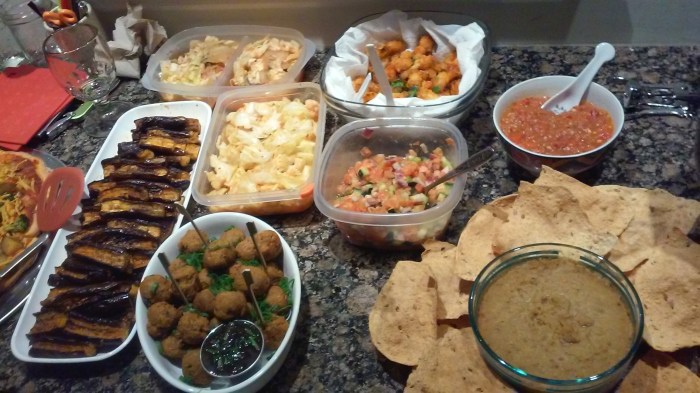
Throughout the evening, I managed to ask most people if they were vegan “in real life”, and all but one said no, but that the food was amazing, and a few people said this with surprise. The one vegan I did speak with also seemed overjoyed to be able to eat every single thing available.
 Food aside, though, what I love about these gatherings is the diversity. Because the meetup is so big now, over one thousand members, I meet new people at every one. I’ve met folks from India, Japan, South America, and Indonesia. I love my friends, and appreciate the ones who like to spend time cooking and eating with me, but I also cherish the perspective brought by sharing meals with people I don’t know, and may, in fact, never see again. Those interactions can be simple and sweet or powerfully memorable. We start with the food in common, and then realize how much life we have in common, too, and the differences help us grow.
As I’ve mentioned in a previous post, I was not successful in getting Meetup to work for me, so I created a Facebook group for the makings of a cookbook club in the Twin Cities. If you’re in the Twin Cities, or visit the Twin Cities with any regularity and want to be a part of it, please join. I want to make a vibrant, generous community here too, and I’d love to have your help.
Edited to Add: This is my first time trying to upload images on this blog, and, as you can see, I leave a lot to be desired. Next time, I’ll include descriptions with the file name, since my screenreader isn’t reading them. Sorry to any blindies reading this, image descriptions with their corresponding file names are below:
Pakoras: Close-up of pakoras and sauce, with slices of green onion on top of the pakoras. Photo by Kwan Mariam, description by Arlie
Many Plates: Lots of plates, including eggplant, pakoras, cucumber and onion salad Cauliflower, a bowl of harissa, papadums with dal, and pizza. Photo by Kayla, description by Arlie
Eggplant: Close-up of eggplant, with bottles of wine behind it and the pizza sneaking into the picture. Photo by Kwan Mariam, description by Arlie
Just Call me Ira
In this post, I claimed I would only ask for support once in this blog. Maybe I should have said “once a year.” I also paid homage to Ira Glass’s asks on This American Life, because he only asks once, too. Once a year.
There’s a paypal button on the front page of this site, where you can click to give a one-time donation in any amount at all to this blog if you feel compelled to do so.
If you’ve been following along, you know that I moved back to Minneapolis at the beginning of August last year. For the past seven months, I have been looking for work. I’m not sure why I always think it will not take this long, and why I told myself I would find something soon after moving back, but it has and I didn’t and so here we are. Every day, before I start in on my grad school work, I troll all the Minnesota job boards. I know the ones that are most likely to give me jobs I’m qualified for. I do all the things career counselors tell you to do: tailor my resume for every job application, get my resume onto just one page, go to specific company web sites instead of just looking at huge hiring mills like Indeed and Monster. I know about informational interviews. I am enthusiastic and scrupulously gramatical in my cover letters, even if I’m not terribly excited about the job. My goal is to apply for AT LEAST one job every day before I start in on any other work. Sometimes I apply for more if there are more I’m interested in, but I have to do at least one. Finding work is my priority. I’ve had a few interviews over the past months which have amounted to nothing. I feel like, for whatever reason, what I’m doing is not working, but I don’t know what else to do, so I keep on. It’s a slog, I won’t lie. It’s depressing. And it’s not getting me paid.
I don’t say this for pity. I’ve pitied myself enough and it’s also not getting me paid. I’m simply saying that if you do feel compelled to donate, please know it will be a huge, momentary relief for me. It will be used to pay my bills, student loans-credit card debt, groceries, Kiva food and necessities. I will use any contribution with intention, care, and gratitude. If you enjoy or laugh at or benefit from this blog in any way, I’d be so grateful if you’d consider a contribution.
In the meantime, I’ll get back to those job applications. And thank you for reading and being a part of this little corner of the Internet with me.
 Blind inFlight